OAM and Stockfish are measuring different things
An initial empirical comparison between OAM's Moment detector and conventional Stockfish engine criticality across five historical chess games. Read this as a beta research finding, not a marketing claim.
5 games · 14 OAM Moments · Stockfish 15.1 · depth 16 · repository OAM package unchanged
In the tested corpus, 0 of 14 OAM Moments coincided with the engine's primary critical ply, and 12 of 14 occurred at positions with less than 50 centipawns of engine evaluation swing. The correlation between OAM's OE_SCORE and engine evaluation swing was r = 0.077.
These results do not show that OAM is better than Stockfish. Stockfish and OAM answer different questions, and Stockfish is a mature chess-engine system while OAM is an experimental measurement framework.
What the result does show is sufficiently interesting to investigate further: OAM's current Moment detector does not appear, in this initial test, to simply reproduce conventional engine criticality.
The next question is whether players and coaches find this different observable useful.
This is beta research. The experiment is continuing.
If you are an IM, coach, chess researcher, or technically minded player, you can read the full report and the raw dataset directly. The production OAM package (`/app/backend/oam/`) is used unchanged; the experimental runner does not modify it.
- REPORT.md — full A–I methodology, common-coordinate dataset, A/B/C/D classification, Evergreen deep-dive, limitations
- dataset.json — every OAM Moment and every per-ply engine metric (114 kB)
- oam_vs_engine.py — experimental runner (Python · reproducible with Stockfish 15.1)
Falsifiable proposition tested
"OAM's current Moment detector is substantially reducible to conventional engine criticality."
Verdict on this corpus: WEAKENED
Read descriptively, not competitively. See § I of the report for corpus-size and configuration limits.
Same trajectories. Different measurements.
Do OAM and Stockfish measure the same function of the chess trajectory?
Not supported, under this experiment.
The same 100 human-game trajectories were analysed independently by the frozen OAM implementation and Stockfish 15.1 at depth 16. Their measurements showed weak event correspondence, near-zero magnitude association, poor reciprocal coverage, and very low deterministic reconstructability. OAM-selected transitions also tended to occur at substantially lower Stockfish evaluation movement than the overall non-mate trajectory.
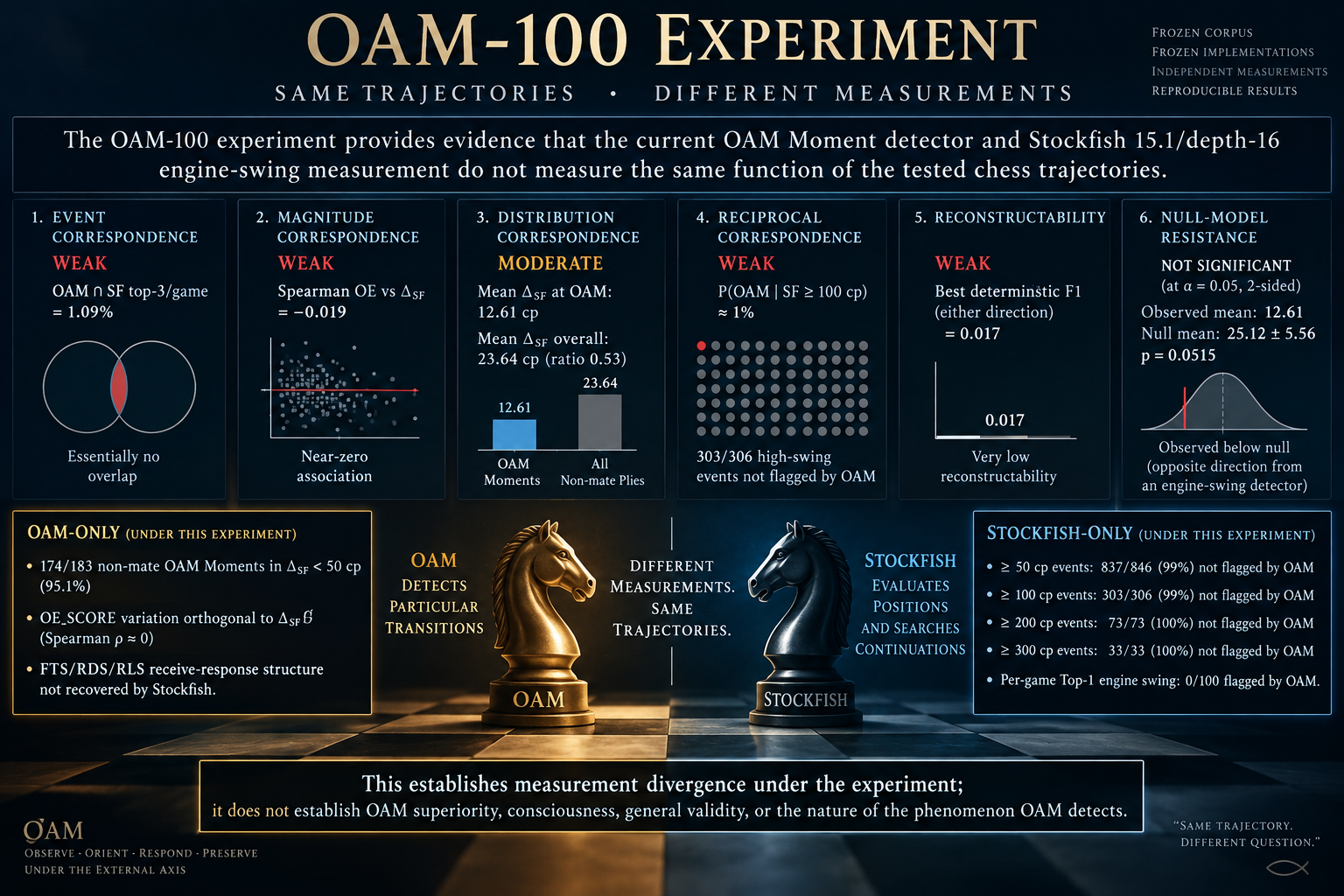
- 174 / 183 non-mate OAM Moments occurred at transitions where Stockfish registered less than 50 cp of evaluation movement under the tested configuration ( 95.1% ).
- OE_SCORE variation was essentially orthogonal to ΔSF (Spearman ρ ≈ 0).
- FTS / RDS / RLS receive-response structure was not recovered by Stockfish.
- ≥ 50 cp events: 837 / 846 (99%) not flagged by OAM.
- ≥ 100 cp events: 303 / 306 (99%) not flagged by OAM.
- ≥ 200 cp events: 73 / 73 (100%) not flagged by OAM.
- ≥ 300 cp events: 33 / 33 (100%) not flagged by OAM.
- Per-game Top-1 engine swing: 0 / 100 flagged by OAM.
This establishes measurement divergence under the experiment. It does not establish OAM superiority, consciousness, general validity, or the nature of the phenomenon OAM detects.
- Corpus
- 100 human games
- Legal plies
- 7,813
- OAM Moments
- 190
- Aligned non-mate
- 183
- Engine
- Stockfish 15.1
- Depth
- 16
- Threads
- 1
- Hash
- 32 MB
- MultiPV
- 1
- Perspective
- White POV
- Comparison
- OAM vs engine evaluation swing
- Null model
- 10,000 cluster-preserving within-game permutations
- Random seed
- 20260215
- Reproducibility
- Byte-identical across two invocations
The frozen Gate-4 artefacts are inspectable here. The corpus, OAM output and Stockfish output referenced by the comparison remain unchanged.
Try it on a game